Explainers
What hospital-acquired conditions are, the 14 CMS categories under the Deficit Reduction Act of 2005, and how the HAC Reduction Program penalizes the worst-performing quartile of hospitals. FY2026 data for 3,055 hospitals.
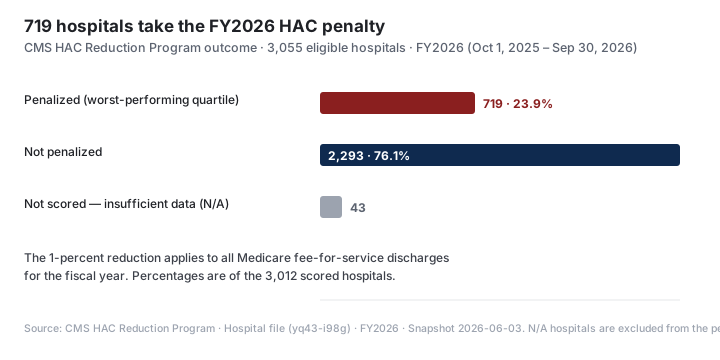
Read →Facility-level FY2026 penalty status and Total HAC Scores, rolled up by state — 719 of 3,012 scored hospitals take the 1-percent Medicare payment reduction. Companion data page to the explainer.
Read →How CMS measures nursing home staffing via the mandatory Payroll-Based Journal (PBJ), the published federal RN hours-per-resident-day benchmark, and where to find county-level staffing data across thousands of US nursing home facilities.
Read →What a Denial of Payment for New Admissions is, how CMS imposes it, how long bans typically last, and which states have the most enforcement actions — with data from the CMS NH Penalties file.
Read →A complete explanation of the National Provider Identifier — what it is, the difference between Type 1 and Type 2 NPIs, how the 10-digit structure works, and how to look up any provider in the federal NPPES registry.
Read →NPI stands for National Provider Identifier. This guide breaks down each letter of the acronym, explains the digit structure, and shows how the NPI compares to the DEA number, UPIN, and other provider IDs.
Read →A step-by-step guide to looking up and checking any NPI in the NPPES registry — what fields to examine, red flags that signal an invalid or misused number, and when a deeper credential check is warranted.
Read →SNF is the medical abbreviation for skilled nursing facility — a Medicare-certified institution providing 24-hour nursing and rehab. What it is, how it differs from a nursing home, and how CMS measures quality across 14,699 facilities.
Read →The 10-character NUCC classification that tags every NPI with a provider's type, classification, and specialization — how the hierarchy works and how NPPES uses it across millions of providers.
Read →The CMS Certification Number — formerly the OSCAR / Medicare Provider Number — identifies every Medicare-certified facility and is the federal join key across the CMS Provider of Services and Care Compare files.
Read →An OIG exclusion bars an individual or entity from federally funded healthcare programs. What the LEIE is, mandatory vs permissive exclusions, and how to screen a provider against 83,001 active exclusions.
Read →Medicare home health is skilled, intermittent care from a certified agency — not the same as non-medical or 24-hour custodial home care. What Medicare covers, the homebound rule, and the 12,392 certified agencies.
Read →PECOS is the CMS Provider Enrollment, Chain, and Ownership System. How Medicare enrollment differs from NPPES enumeration, and what the public file's 2.98M enrollments reveal.
Read →Hospice is comfort-focused care for a terminal illness with a six-month prognosis. The Medicare Hospice Benefit, who qualifies, and the ownership mix across 6,943 Medicare-certified hospices.
Read →Dialysis filters the blood when the kidneys fail; ESRD is the final stage of chronic kidney disease. Medicare ESRD coverage and the chain-ownership concentration across 7,557 dialysis facilities.
Read →Medicare is age-based federal coverage; Medicaid is income-based and joint federal-state. Who each covers, who pays for nursing homes, how providers enroll, and the 83,001 exclusions that bar both.
Read →An ASC is a facility for same-day surgery without an overnight stay. How it differs from a hospital, the ASC-1 through ASC-12 quality measures, and the 5,611 Medicare-certified ASCs with 100% NPI coverage.
Read →Non-medical custodial care — bathing, meals, companionship, 24-hour aides — is not covered by Medicare; skilled home health from one of 12,392 certified agencies is. The difference and who pays for each.
Read →"Provider ID" is not one thing. How the national NPI relates to a Medicare PTAN, payer-specific provider IDs, and the EIN/Tax ID — and which one a form is actually asking for.
Read →Getting an NPI is free through the CMS NPPES system. The steps, what you need, Type 1 vs Type 2, and what happens after — the record joins the 8.9M public NPIs and PECOS comes next.
Read →The SFF program flags the worst-performing nursing homes for roughly double the inspections. How it works, SFFs vs candidates, and how rare it is — 85 active SFFs out of 14,699 nursing homes.
Read →CMS Care Compare is Medicare's official facility-quality comparison tool. The facility types it covers, how star ratings work, and how Fonteum mirrors all of it with provenance on every field.
Read →The OIG LEIE bars providers from federal healthcare programs; SAM.gov lists government-wide contracting exclusions. Why compliance screens both plus state Medicaid lists, across 83,001 active OIG exclusions.
Read →CAQH ProView lets providers submit credentialing data once for many health plans to reuse. What it is, the re-attestation cycle, and how self-reported data differs from primary-source federal records.
Read →The 1-to-5-star score on Care Compare for nursing homes, home health, dialysis, and hospitals. How CMS calculates it, which settings carry a star, and what a single star can hide across 14,699 nursing homes.
Read →Medicare certification means a facility met the federal Conditions of Participation and can bill Medicare. How a home health agency, hospice, or nursing home gets certified, and how to confirm it in the federal file.
Read →Home health is skilled care to help you recover; hospice is comfort care for a terminal illness. Who qualifies for each, what Medicare covers, and the difference across 12,392 home health agencies and 6,943 hospices.
Read →Palliative care relieves symptoms at any stage, alongside treatment; hospice is comfort care once a terminal prognosis is set. How the two differ, what Medicare covers, and the 6,943 certified hospices behind the benefit.
Read →A skilled nursing facility is Medicare-certified 24-hour medical care; assisted living is state-licensed residential care. Why only one appears in Care Compare, and what each level of care includes.
Read →Home health brings skilled care to you intermittently; a skilled nursing facility provides 24-hour care in a certified facility. Who qualifies, what Medicare covers, and how staffing data sets the two apart.
Read →A Type 1 NPI identifies an individual provider; a Type 2 identifies an organization. How the two differ, when a provider needs both, and how to tell which type any NPI is in the federal NPPES registry.
Read →An IRF delivers intensive therapy — about three hours a day — for people recovering from a stroke, injury, or surgery. How it differs from a nursing home, and the 1,221 certified IRFs CMS tracks.
Read →An LTACH treats medically complex patients who need hospital-level care for an extended stay, often after the ICU. How it differs from a hospital, an IRF, and a nursing home, across 317 certified facilities.
Read →CMS publishes the owners of every certified nursing home — chains, private-equity firms, and real-estate companies. How the ownership data works, why it matters, and how to look up who owns a facility.
Read →More explainers are added as Fonteum publishes new federal-data topics. Browse the research studies and the hospital cost report data for the underlying datasets.
Frequently asked questions
- What is the Fonteum Learn hub?
- The Learn hub is Fonteum's library of plain-language explainers for US healthcare policy and federal data. Each explainer answers a definitional question completely, cites the primary federal sources, and links to the underlying facility-level data so any figure can be traced to its origin. The inaugural cluster covers hospital-acquired conditions and the CMS HAC Reduction Program.
- What does the hospital-acquired conditions guide cover?
- It covers the CMS definition of hospital-acquired conditions, the 14 categories under the Deficit Reduction Act of 2005, how the Present on Admission indicator drives the payment provision, and how the separate HAC Reduction Program penalizes the worst-performing quartile of hospitals with a 1-percent Medicare payment reduction. It is a policy and data explainer, not clinical guidance.
- Where can I find facility-level HAC penalty data?
- The companion research page, HAC Reduction Program Penalties, publishes FY2026 facility-level penalty status and Total HAC Scores rolled up by state, sourced from the CMS HAC Reduction Program Hospital file. Among the scored hospitals, 719 — roughly the worst-performing quartile — take the 1-percent payment reduction.
- Are Fonteum's Learn explainers medically reviewed?
- Yes. A non-practicing medical reviewer checks each explainer for source interpretation, terminology, and limitations language. The reviewer does not provide clinical advice; the explainers cover regulatory and data accuracy, not patient care.
- How current is the HAC data on Fonteum?
- The HAC figures reflect the CMS FY2026 program year, read directly from the CMS Hospital file in the CMS Provider Data Catalog at the snapshot date shown on each page. CMS refreshes the file annually by federal fiscal year; Fonteum re-reads it on each publish and records the new snapshot date in the provenance chain.
Look up providers & facilities
Every study above is built on the same source-traced provider graph. Look up an individual provider, a specialty, a state, or a Medicare-certified facility — each record carries field-level provenance back to its federal source.
- Alabama
- Alaska
- Arizona
- Arkansas
- California
- Colorado
- Connecticut
- Delaware
- District of Columbia
- Florida
- Georgia
- Hawaii
- Idaho
- Illinois
- Indiana
- Iowa
- Kansas
- Kentucky
- Louisiana
- Maine
- Maryland
- Massachusetts
- Michigan
- Minnesota
- Mississippi
- Missouri
- Montana
- Nebraska
- Nevada
- New Hampshire
- New Jersey
- New Mexico
- New York
- North Carolina
- North Dakota
- Ohio
- Oklahoma
- Oregon
- Pennsylvania
- Rhode Island
- South Carolina
- South Dakota
- Tennessee
- Texas
- Utah
- Vermont
- Virginia
- Washington
- West Virginia
- Wisconsin
- Wyoming